Cleat position
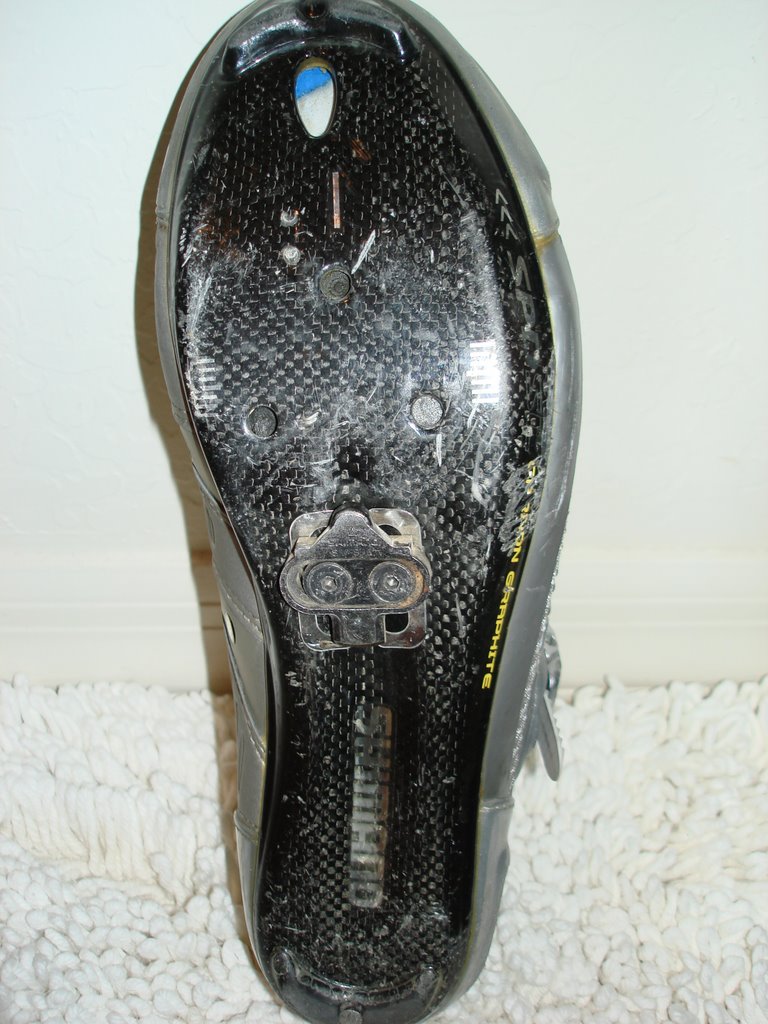 Why do we place the cleat under the ball of the foot on our cycling shoes? I can find no evidence to support this location. It appears to be simply a result of tradition--cyclists have always done it that way. Last July former pro cyclist and shoe designer Goetz Heine (www.biomac.biz) suggested I try putting my cleats in the arch of my shoes. With some skepticism I tried it. To my amazement my performance improved. In fact, my power-heart rate ratio which I tracked for years improved by 9%. That's a huge change.
Here you can see a picture of my Shimano road shoe with an SPD mountain bike cleat in the arch. I used a mountain bike pedal since the cleat has only two holes and I didn't want to punch too many in the shoe. Crank Brothers pedals also work well for this position.
Since changing over last summer I've done some searching of the scientific literature and found only two studies which looked at the traditional vs. the aft cleat position. Both found there was no difference whether the cleat was under the ball of the foot, at the arch area, or somewhere in between. And those studies were done with experienced cyclists who had not adapted to the arch position.
So is there an advantage in placing the cleats farther back? I believe so. Economy - how much effort it takes to ride at a given power output - improves. There may be lots of reasons for this which I won't go into here. Another advantage is that the biggest muscles of your body - the quads and glutes - are used more since the calf - a relatively small muscle - is now less active and no longer serves as a "transmission" for the biggest muscles. This latter point is especially beneficial for triathletes who rely on those calf muscles as their primary mover when they start the run. Fresh calf muscles mean a better run.
Should you try it? I've suggested to all of the athletes I coach that they move their cleats back toward the heels as far as they can. All that have tried it reported feeling more powerful. The next step for those who use Speedplay pedals will be to try Speedplay's new adaptor (cost $25) which allows them to put the cleat even farther back. If that still feels OK then we will talk about either modifying their existing shoes (not all can be re-drilled) or having custom shoes built (Rocket 7, DS Shoes, BioMac).
Labels: cleat position, midsole
posted by Joe Friel @ 6:15 PM
143 Comments




143 Comments:
How did it affect bike handling? Cornering etc? Off the top of my head I would think that would limit body english significantly.
Two issues I see here:
1. Moving the foot forward will generate substantial toe-to-tire overlap. I've ridden bikes with some overlap, and it's no big deal -- if the shoe rubs the tire, I'm going slow enough it doesn't matter much. But this seems like it might be a bit heavy on overlap.
2. It seems to maintain the same range-of-motion in the knee, you'll want to move your seat forward to compensate, with a longer stem to compensate. Without these changes, you might be confounding body position with cleat position.
What about high cadence and sprints?
Susanne Ljungskog used it to be 15th at last WC TT..
http://perso.orange.fr/cyclinfo/Susanne%20Ljungskog.jpg
"I've suggested to all of the athletes I coach that they move their cleats back toward the heels as far as they can."
How about this?
http://img266.imageshack.us/my.php?image=sidihitechcarbsoleuj0.jpg
G'day to all,
To Dan, don't move your seat forward, assuming of course that you have a reasonable position. The substantial drop in seat height required to allow mid foot cleat position will take care of seat position.
Re toe overlap; if you are ducking and diving on the track it may be an issue but for general riding is livable providing you don't track stand too much!
The gent behind this cleat position is Gotz Heine and in my experience to date he is a credible person with well reasoned views and a large bank of testing data to back them up.
Regards,
Steve Hogg
Hi Joe...Steve Neal here...never seen your blog before this is great.
I have my cleats about 1 inch behind the ball of foot and really like it...have only tried on road so far...
Do you know anyone who has tried this mtn biking?
As Steve Hog said, the new cleat position means a lower seat position. For me with my 1,94 cm length, the arch cleat position in combination with the low built height of the biomac shoe let to a 4,3 cm lower seat. This was the result after a fitting and torque analysis session by mr Heine. This position gives me, besides increased power of about 10 %, comparable to what Joe found for himself, also a lot lower point of gravity and therefore better cornering and descending.
any thoughts as to how middle-of-the arch cleat placement affects power output and/or efficiency and/or mechnanics during low cadence, steep climbing and during steep, out of the saddle climbing? this is when the lower leg and calf muscles are typically recruited to a greater extent to assist the quads.
Sorry for the long delay everyone. Too much travel and work...
Lynda--My impression is that it improves handling since you have a lower center of gravity.
Dan--Mine overlaps to about the base of the big toe. Very slow (5-6mph) turns have to be cautious. I scuffed my shoe a few times when I first made the switch. Actually had to move seat aft a bit. As saddle goes down it also goes forward.
Clythio--My cadence increased when I made the switch (I've bee tracking cadence etc for as long as I've had a power meter--1998). I'm not a sprinter but greater power will probably translate to a faster sprint.
Steve Neal--No, I sure don't. Not coaching any MTBers now. Why don't you try it and tell us?
Greg X--My impression is that the calf does not provide significant power to the pedal. It is merely stabilizing the ankle. Power comes largely from quads and glutes. It would be like doing squats on the balls of your feet vs with heels on floor.
Can you post some information about the Speedplay adapter? I tried to find it but didn't have any luck.
Thanks
Terrance--It's not on their website. You'll need to email them to ask about it. Their addy is on their website--"contact us" or some such thing.
I participated in a biomechanics study at Ball State Universtiy a few years back testing this very concept. The study was performed by Jeff Frame for his doctoral disortation. My power was greater at the balls of my feet, but a) not by much and b) most likely due to my training for years that way. Jeff Frame has much information/interest in this subject. Pearl Izumi sponsored the study and donated the shoes we wore.
did it [move it back on my LG sponsored shoe, sorry, had to plug], it works, i can really tell a difference, more power, but really my pedal stroke feels a lot smoother [even on my powercranks]. i did have to lower the saddle a bit. so lets recap, did it, it works, love it, now don't tell anyone....
Speedplay has them For $25 total set back is 13MM. It is an aluminum base plate similar to the black plastic one. It will allow you to move the cleat independent of the base plate so the cleat can go further back.
@ ptapgeek
I do not advise to move the cleats back by 13 mm from the metatarsal/traditional position as in fact this arrangement may result in disturbances of the muscle chain. What I do promote is to build a shoe where you position your cleat under the tarsometatarsal joint, the midfoot, as this is the only position where the body automaticaly takes full advantage of the huge power of quads and hamstrings, therefore pedal way more efficiently.
I have moved by cleat position as far as it alows on my shoes, about 1.2 cm behind the ball of my foot. I did adjust by saddle height, but did find a bid of benifit b moving by saddle about 4 mm forward. Just my experience, but i a real happy with the results anthough i do find that I spin up a bit slower but am able to maintain the same high cadence.
Any tutorials out there on what shoes can be modified and how and where should the holes be drilled? I'd like to give it a try
I would think any soles that are weaker than a steel (or carbite) drill bit should do. I'd suggest drilling the holes in "your" shoes the same pattern as your cleat suggests. I'm sure the folks on here can provide you with more specific instructions, a tutorial if you will.
I just did the conversion and it looks good. I used some plates from my old spd shoes. First Im going to move back the cleats in my normal shoes and then I will try this.
I would know the citation for the studies you viewed Joe(author, title, etc.). Was one based on a recent abstract at the 2006 meeting of American Society of Biomechanics titled "Kinetic and Kinematic Effects of Altering Cleat Placement During Cycling" by Frame & Dugan?
Linked here.
I'm trying to figure out where exactly the tarsometatarsal joint would be? Do you have an image of a person's foot and an way to mark that image where the metatarsal joint should be and etc?
My understanding is that the tarsometatarsal joint is just forward of the inner ankle bone, almost to the boney protuberance just below and forward of the inner ankle bone.
WOW, that's back there!
Joe
Where are you positioning your saddle when using a midsole cleat. It strikes me that this position is also an important part of the increased power-heart rate ratio that you're seeing?
Traditionally, the most important factor in determining the correct setback is the length of the cyclist's femur. As such, and as you know, the saddle is positioned so that the knee's center of rotation is directly over the pedal axle of the forward crank arm when it's horizontal. To determine this position a plumb line is dropped from the riders knee cap so that it intersects the ball of the foot and pedal spindle when the forward crank arm is horizontal. Are you now moving this line from the knee cap to the ball of the foot back to the mid-sole?
If the previous sentences sound familiar I'm paraphrasing Andy Pruitt, which of course is part of the traditional method of establishing the riders saddle position when the cleat is under the ball of the foot.
Thanks
Wayne
I've always been intrigued by Floyd Landi's pedal stroke. It seems that he either has a huge feet or his shoes cleats are positioned towards the middle as well. I did moved back, and I sort of feel more powerful, it seems I am able to push a bigger gear now. Interesting blog, it just being added to my RSS feed.:)
Hi. I'd like to drill some shoes and place a Keo cleat in the midsole position. Can anyone help me with drilling advice?
I'm experienced in drilling wood, but a little scared to drill carbon fiber. Will most soles support this (handle the load)? Is a three-holed attempt asking too much? Everyone else does two-holed. Thanks in advance for your help.
Murphy--Sorry for the delayed reply. I wouldn't recommend a 3-hole drilling in the midsole. Depending on the design of the shoe, there is a chance the cleat will not fit flush. I've used only 2-hole cleats with modified shoes.
Joe - you mention you only use two hole cleats. What pedal type do you use?
I have speedplay and look keo pedals but those are both three and four hole cleat types.
Questions on shoes - you reference the biomac shoes in your posts. Can you purchase those shoes with the cleat holes already built in this position? It was a bit hard to tell from their website. Any other shoe companies that have cleat holes with this position?
Thanks!
Dave
Joe - you mention you only use two hole cleats. What pedal type do you use?
I have speedplay and look keo pedals but those are both three and four hole cleat types.
One final question - you reference the biomac shoes in your posts. Can you purchase those shoes with the cleat holes already built in this position? It was a bit hard to tell from their website. Any other shoe companies that have cleat holes with this position?
Thanks!
Dave
Dave--I use Eggbeaters but SPD mtn bike pedals also are 2 hole. Using 2 hole because the contour of most shoes in arch area will not allow for a flush fit of 3-4 hole cleats if shoe is modified. Biomac shoes are the only ones I know of that come pre-drilled for mid foot position.
Mechanically, I am not so sure about this. The calf is a muscle that is used but should not be a gating factor. So, the weaker the calf, the farther the set back but eliminating the entire muscle seems like a bad idea. For spinning the calf does not really matter, but I don’t know of anyone that gets dropped spinning. Ask a sprinter, and they will tell you where their cleats go. Ask a sprinter if longer feet help. Also, using the squatting analogy, no one runs on their heels unless they are going backwards. The last issue deals with being able to drop your heels into he power part of the stroke. By dropping the heels, the 2 to 4 power part of the stroke where we generate 80% of our power is extended to 1 to 5. The shorter the arm gives you less ability. But then again, what do I know.
I have some questions about Mr. Heine's results in light of the study done at UCDavis on the effects of cleat placements; they found no conclusive evidence that position matters at all. This is the abstract link
http://www.ncbi.nlm.nih.gov/entrez/
query.fcgi?db=pubmed&cmd=Retrieve&
dopt=AbstractPlus&list_uids=169014
93&query_hl=2&itool=pubmed_docsum
Mr Friel or Mr. Hogg can you help me reconcile the differing results by these academics? I can email you a copy of the pdf if would like.
How do you adjust seat post position? I got the Speedplay aluminum plate fore aft adaptor and I am back around 17mm from my normal posiotion. Do I lower the seat post the same 17mm? I got these to help my achilles tendonitis but ironically have noticed a little exacerbation of my symptoms. Thanks. Drew
Anon--Yes, you'll probably have to lower your saddle. Moving the cleat aft 17mm will essentially shorten your leg. Hard to say exactly how much. But be aware that as the saddle goes down it also goes forward about 3mm for every 1cm or so of vertical change.
Gosh, I have no idea why a midsole cleat would aggravate your Achilles. Seems like it would be just the opposite.
Anon, that's what I keep saying - a half-hearted approach to bio-mxc², i.e. shifting your cleats by just a couple of millimetres back, can lead to disturbances in the muscle chain. Therefore either cause irritation of the achilles tendon(little rearward shift)or knee problems (more but insufficient rearward shift, i.e., 10 to 20mm from the ball-above-axle position only). That's some of the reasons why we from biomac Ltd. went through the drama of designing and bringing onto today's cycling shoe market an entirely new cycling shoe - to exclude all possible risks for the arch-cleat user and to improve cycling shoes from scratch in regard of weight, foot-burn, fit and stack-height. So far, practice has been proving us right as apart from some customers who do prefer to continue using their three- or four-hole cleat systems, none of them has been hampered by any of the well-known ailments common amongst users of the traditional cleat position.
Anon, that's what we keep saying - a half-hearted approach to bio-mxc², i.e. shifting back your cleats just by a couple of millimetres, can lead to disturbances in the muscle- chain, therefore either result in irritations of the achilles tendon(mostly with little rearward shift) or knee problems (more,but insufficient rearward shift, i.e., 10 to 30mm only). While there may be small community of riders who due to a history of old injuries may resort in this 'luke-warm' area, the majority of cyclists do nothing but benefit from a clear 'adieu!' to forefoot pushing.
For those, we from biomac Ltd. went through the rough task of developing an entirely new cycling shoe - extremely lightweight,in order to cut down on both, rotational and total weight of the rider, minimum stack-height to improve a cyclist's contact to the pedal and point of gravity, better ventilation and foot climate due to strict absence of glues within the shoe and, last but not least, fit due to a custom-mouldable fitting system and a broader middle section of the sole so to also host various cleat types.
Throughout the comparatively short history of biomac shoes, practice has proven us right as apart from few cyclists who had not been positioned correctly or been hampered by old histories of injuries, everyone else would nothing but benefit from the numerous advantages of bio-mxc² and comfortably forget about the well-known shortcomings of traditional cleat positioning.
It seems to me the easiest way for people to test the benefits of arch cleats would be to swap out your pedals for bmx pedals, then try riding with your foot at different positions, standing and seated.
Or just go to the gym with those uber adjustable 'spinning' bikes, and fiddle with your geometry adjustments and foot placement there.
Hi - my interest with mid arch cleat placement deals more with comfort than power or efficiency. I have an abnormal descepancy in foot lenght and girth. My left foot is almost 2 full American sizes longer than my right; while the girth of my right foot around the ball of the foot is somewhat larger than my left. Most of these foot variations are in my forefoot. From the arch back, my feet are very symetrical. This descepancy in foot geometry has made finding snug fitting athletic shoes a nightmare. For cycling, custom Rocket7's have cured most of my ills. On long hot or very intense rides however, I still get the dreaded hot numb pain - especially in the ball of my right foot. I believe that a mid arch cleat placement, since it may more uniformly distribute pressure on the foot, may relieve or eliminate this pain. Has anyone noticed an improvement in foot comfort, with their mid arch cleats?
Bob--No one has mentioned this to me. My wife has a lot of forefoot discomfort on long rides. She is getting ready for a century in the mountains in July so I will be moving her cleats to midsole to see if that helps. If you do try it please let me know what you found.
Joe and all:
Can anyone provide the mechanical/technical details of drilling through the sole and safely securing the cleats. I'm probably okay with the drilling part, but I'm not sure how to actually secure the cleat screws to the sole. I currently use Sidi Genius 5 shoes and speedplay pedals (I'm already using the new fore/aft speedplay plate), but have used 2-hole spd in the past and will use them again if necessary. Regardless of how many holes I drill (3 vs. 2), I just don't understand how to duplicate the manufacturer's, factory-installed cleat screw receptors. Can anyone provide a step-by-step account of how to actually modify the shoe? Thanks in advance.
Rosie--Not all cycling shoes can be modified for a midsole cleat. If yours can go to your local bike shop and get 2 female bolt receptacles and bolts for MTB cleats such as SPD. They will probably have to fish around in their bolts boxes to find some. Depending on how thick the soles of your bolts. Then drill 2 holes in the shoes. This is the tricky part. They will be evenly spaced between the toe and heel and on line with the center line of your existing cleat. This is the tricky part. It takes some eyeballing to get it right. You can also go here-- http://www.cyclingnews.com/fitness/?id=2007/letters06-19 -- to read Steve Hogg's much more detailed description of how to install your cleats.
I've been thinking about putting a picture of a template on my blog since I'm asked this so often but have been traveling for 3 weeks with more to go. Watch for it.
Joe - if anyone is interested in my "comfort" test data, they can check out my report on my team website:
http://www.westwoodvelo.com/showthread.php?t=1882
The test was encouraging but inconclusive because I was unable to get a true mid arch cleat setting, and I was using old, well stretched shoes.
Joe,
My right knee is wrecked. After 4 knee op's it doesn't bend past 90 degrees. I have always had to pedal off of my arch on my right foot. In the past I have used Power Grips on my MTB. Problem with Power Grips when your going bite it there is no getting out of them. I cam across your blog and have since modified 2 pairs of MTB shoes, one with SPD cleats and another with Eggbeaters (2 different bikes). You need to get a pedal that has the least degree for release. Shimano at 13 degrees is easier than the Eggbeater at 15. Problem is that your turn out is more difficult from the arch area rather than the ball and sometimes the toe of my shoe hits the crank before I get out. This probably isn't a prob with road biking. But as you know MTB sometimes you want out quickly. I'm going to give a 3 hole a try on my road bike. I'll let you know how it goes.
Thanks
Dave
I couldn't follow up by modifying my Road Shoes with a 3 hole Cleat. Most of the shoes I looked at had a sole that was too narrow at the Arch area to mount a 3 hole cleat. I did buy an awesome pair of shoes from Rocket7. They modified the shoe and put the base plate in the Arch, and it was set up for 3 hole Cleats. The Shoes were way more than what i needed in the way of performance and they are expensive. Although I needed the Arch Mounted Cleat due to injury rather than most of the others on this blog. So I can't tell you if it works better to pedal off of the Arch or the Ball as I always have had no choice but to pedal off of the Arch position. What I can tell you is this shoe has made it possible for me to have the performance of being clipped in. I couldn't be happier! Thanks to Dean and the folks at Rocket7. Your shoes are Great!
Dave
DaveB,
You are correct about the added difficulty in releasing the clip. I modifed my road bike that has Eggbeaters and now I would like to do the same for my MTB. I am going to purchase a new pair of MTB shoes is there anything I should be on the lookout for?
I'm in favor of the midfoot cleat position. In my intuition, that tells me that the pedaling forces are more spread out across the foot rather than on the ball of the feet. Atleast in my case, there's a lot more flesh in the mid section. This may avoid burning and hotspots that many folks complain about.
The calves also don't have to involve themselves in stabilizing the feet. Thats wasted motion really.
I'm going to do a 20 min time trial and see how my average power differs...
Joe, did Floyd really have his cleats midfoot? I thought I read someone's comment saying so...
Ron--Not that I know of. Tyler has recently though, at least according to one photo that made the rounds a few months ago.
Hi Joe,
I raced a 24hr race this weekend, but had to pull out at 11hrs due to extremely sore achillies tendons on both legs.
Do you think that changing cleat position to as close to mid sole will help?
This is a big change in position.
I have moved them back as far as they will go on my S
Shimano MTB shoes
I have MTB pedals on my road bike as well.
thank you
Jason.
Jason--No way of knowing for certain. There's only one way to find out.
Why not have two Cleats? one 'traditional' and one in the arch. During a long ride the rider can swap when he feels like it?? or am I missing something painfully obvious?
m,waller--I kind of did that a couple of years ago. Had a pair of shoes drilled for both positions. Found I never wanted to use the forefoot position, though. Midfoot was much more effective for me.
Due to a neurological problem, I can only achieve sufficient power by using the arch of my foot. I now find that I will need to move to recumbent trike bike for added stability. Have you any experience or thoughts about moving the cleat back for pleasure riding a recumbent bike
thanks
bruce--No, I've never had any experience with mid-sole cleats for recumbents. But I don't see why that would make a difference. Let us know what you discover.
bruce--it works great!Talked some of them into it and they simply love it although they do not benefit from all the other aspects such as lower point of gravity, better aerodynamics or bike handling.especially on climbs they feel so much better. soon our site www.biomac.biz is renovated we will publish some pictures. Go and try yourself!
bruce--we talked some recumbent riders into using bio-mxc²(arch cleat)and they feel it works great, especially on the hills. although they do not benefit from lower seat, better handling or improved aerodynamics they feel stronger on their bikes and produce sustained effort.soon our site www.biomac.biz will be back online we will publish some photos of these guys.
I am using speedplay zero pedals & cannondale by diadora shoes size 41 and moved my cleats rearward i.e over the ball of the smallest toe.
I am currently trying different cleat positions: 2 weeks ago I placed the cleats about 5mm from the middle of the arch, lowered the saddle by 12mm and took my bike for a 25km ride, I experienced soreness on both my hamstrings, so I moved the cleats forward over the ball of the smallest toe & raised the saddle 5mm. I now feel no soreness with my hamstrings & I will try this cleat position for several more weeks.
Regarding control/bike handling, if you are standing out of the seat you have much better balance over your wheels when the cleat is centred under the foot. We recommend this for mountainbikers especially where handling skills are important. It is great for climbing and sprinting too so no real disadvantage.
Anon, no wonder you experienced sore hamstrings as switching from traditional ball-above-axle to bio-mxc²(arch-cleat) you will need to lower your saddle something like 20-25mms(!). Using our Y²shoes you will be able to lower your seatpost around 35mms (+/-5mms)due to reduced stack height. Enjoy!
This is all very interesting. Common sense tells experienced cycling veterans if making changes...do it slowly and methodically. Maybe only move your cleats back 2mm once per 2-3 days. Ride, then adjust again as needed. If you move cleats back too fast you run the risk of creating sore hamstrings, sore knees, etc. Bottom line, using a Computrainer can tell if you really are generating more or less power. Good luck.
Nobody seems to note in all this arch-cleat discussion that moving the cleat back effectively increases your lever arm through the power stroke (1 to 5 o-clock), shortens it through the back stroke (7 to 11 o-clock) and leaves it unchanged at the top and bottom (as opposed to longer cranks which increase the lever arm all the way around).
@anon Moving the cleats back gradually hoping the body would slowly adapt is as if would set out to jump a bar using a straddle technique and then, suddenly switch to the Fosbory flop. Understand that although bio-mxc²(arch cleat) takes advantage of the same muscles involved in spinning it uses them in a totally different but far more efficient slope. At the same time when you think of the spinning movement as a circle it is obvious that the foot spends more time (and centimeters) in downstroke action, therefore needs less force to do so. This is the simple but effective essence about bio-mxc²(arch cleats) as can be seen on:
http://biomac.webstudios.at/index.php?option=com_content&view=article&id=16:tretpiktogramm&catid=1:text&Itemid=9
Joe,
With great interest I have been reading this blog. 9% increase is power/heart rate ratio is enornmous and therefore I am more than willing to move my cleats further back.
However, I miss one aspect in your article: what pedaling style do you have? I am a mountainbiker who tends to pull his pedals significantly as well. Therefore, my pedalling style is probably quite a " nose down" style and not so much Lemond style.
Thus my question, how is pedalling style (and probably corresponding leg mucsle composition) affected by moving your cleats further back?
Thanks in advance,
Tibor
tiborgijssen AT hotmail DOT com
Tibor--I have no experience working with MTBers who use a midfoot cleat position so I really can't say. It may well be that bike handling in highly technical situations is not as good in this position. My son who does a lot of criterium racing at the pro/1/2 level believes that he is not quite as agile in the technical cornering necessary in such short course racing with his cleats mid-sole.
Fair enough, I have (un-scienctifically) experimented about with my cleat position. The good thing for MTBers is that one can lower his saddle and in some cases move the saddle a bit forward as well, this improves handling! However, I also found that indeed it's harder in technical situations to handle your bike when your standing on the arches of your foot. I guess that MTBers have a different stroke where we tend to pull a lot as well in order to have the smoothest power transfer on our back wheel (as described by A. Pruit). For me, it was harder to have this push/pedal style when my cleats were farther back, any other experiences?
I do have another point of concern about something which I have never understood about cleat positioning. As you said before, there is no scientific evidence that your cleats should be exactly under the ball of your foot. Still, there are riders who have a different left and right cleat positioning in order to have both cleats under the ball of their foot in the case of different foot length (but still using one shoe size for both feet). But by doing this they create an effective leg length difference and thus I would assume they probably end up in some weird position in order to compensate this difference! Am I correct or missing something?
Tibor--Thanks for your experienced comments. Interesting. I agree that MTBers do more pulling up to smooth their strokes to prevent rearwheel slippage. They've been shown in research to be the most economical of the cycling disciplines because of this. That may well have an impact on cleat position.
I would agree with you that feet of different sizes on a single rider with cleat position under the ball of the foot would appear to compromise this economy not only for MTBers but also any other cycling discipline.
I am convinced that the arch-cleat position, especially on mtb, is conducive to a low and very forward saddle position coupled with a short crank, which is counter-intuitive for mtb riding as far as tradition goes (traditionally, mtbs have longer cranks). We know standing consumes more energy, but with the lower and forward saddle and short crank, I'm finding it easier to spin in the dirt while seated (how often did you see Ulrich stand?). It seems, so far, that I can continue power through the bottom and up and over the pedal stroke (more pulling force). The lower forward saddle caused me to add 2 cm to my stem; this combination has improved my handling, to my surprise. First race tomorrow with the set-up, I'll see how it goes.
Anom-- the positive effects you described are caused by modifications of your bike setup, probably because a different cleat position allowed/forced you to make those modifications; they are not directly caused by an arch-cleat position. However, interesting that you still feel your upperstroke is still quite powerfull, curious how your race experiences are!
Joe- you agree with me that cleats should should be positioned on the same place for both the left and right shoe (assuming equal shoe, not necesirally foot, size)?
Excellent read - thanks to all who are sharing their knowledge.
I'm interested in this for bmx racing. For my personal setup, i'm using the "arch cleat" positioning to bypass my calf muscles that are very weak due to a spinal cord injury (moto-x accident in the past).
I'm looking for a good shoe to modify, hoping to get some suggestions from those that know what is out there. Flat bottom near the arch, stiff sole, etc. I can sand down lugs and what not so not an issue. I'm currently using some modified bmx shoes with a plate added below the sole to create a cleat mounting platform.
Regarding power, etc discussion... I see that archcleat positioning bypasses another muscle and therefor form of shock absorption. In bmx, when coming down hard from a jump, I can see that this could become an issue over time (I think my ankles are going to take most of it) - So I still think it is a good idea to run on the ball of the foot, but for me, it is my only choice - and it allows me to race instead of sitting on the sidelines.
Thanks in advance for shoe suggestions, and please keep up the discussion!
I'm an ultra long distance cyclist (randonneur) and, to counter minor knee pain, switched in the spring of 2007 to Speedplay Frogs. At the time, I thought it was the best thing I'd ever done (no knee pain, could walk in MTB shoes and could unclip easily when very tired). But I soon developed severe achilles tendonitis, and took this year off, trying to avoid surgery.
I've always suspected my beloved Frogs, and now I find this:
http://www.beginnertriathlete.com/discussion/forums/thread-view.asp?tid=122612
As I recover, I feel that, indeed, when using Frogs there is still a bit of stress on the AT which, on very long rides (I haven't tried yet), might well result in the same condition. So, today, I used PowerGrips, which allow me to pedal with my foot far forward. There was definitely no stress on the AT.
I don't know if I want PowerGrips to be my ultimate solution (lots of pluses and minuses), so I'm likely to consider custom shoes with mountain SPDs mounted over the tarsometatarsal.
Ken, last year winners of the RAAM's team leg switched to biomac shoes and bio-mxc² position only hours prior to the event. Although one of them hadn't even trained on the shoes and position they won the race with more than a day ahead of the runner ups. Switzerland's Beat Knechtle (triple-Ironman)had his finest year when riding in our shoes. Andrea Clavadetscher, ex-RAAM-winner and 24hour World-Record Champion takes advantage of our shoes and the midfoot position. Throughout their career in our shoes none of these 'randonneurs' or any other long-distance competitors ever experienced any problems whatsoever with their knees let alone their achilles tendon. Need more evidence?
Last summer while recovering from a knee injury (torn right MCL) I had complications with deep vein thrombosis in the same leg. This has left me with chronic muscle cramping in the affected calf.
Switching from ball of foot over pedal axle to a mid-foot cleat position has helped tremendously with pedaling comfort… Plus, refitting around the new cleat position has alleviated most of what I used to think were "overuse" aches and pains.
My current "compact" style road bike has proven pretty adaptable to the changes, most notable, a 2in drop in saddle height, but the head tube is a bit tall , and the obligatory toe over lap is substantial.
My question is if anyone following this topic might have knowledge of anyone building road frames that take this cleat position and the fitting "idiosyncrasies" into account??
Thanks in advance, Tod
I have an old pair of road shoes gathering dust somewhere. Can't wait to do this little experiment for mountain biking with eggbeaters ! Cheers
I have now modified 3 pairs of MTB shoes to have arch mounted cleats. I ride difficult trails on South Mountain in Phoenix. I have no choice and due this because of knee injury. I will tell you that i have no issue with Pedal Power from this position. I have also had 1 pair of road shoes and 1 pair of MTB shoes made by Rocket 7. I don't use the MTB shoes often because they are just too nice and i don't want to ruin them. It is easy to modify a shoe if need be.
Good luck
Dave
Ken,
Powergrips are great until you need to get out of them when your body weight is going forward. I had a couple of crashes that I got really tangled up in the bike because my feet didn't get out.
Dave
Tod,
If you have toe-overlap issues, maybe consider a time-trial frame which has a long front-center.
Just a thought.
Joseph
I found this post while googling for info about how cleat position can be used to compensate for leg length discrepencies. Very interesting.
My left leg is about 2cm longer than the right. This makes finding an optimal seat height difficult. I am 193cm tall, and with 175mm cranks I have my seat around 83cm. But this is too low for my left leg, and I have to hyper-extend my left knee every few minutes to make it "crack" and then it is comfortable agian for a few minutes. If I have the seat higher, the knee is fine, but other discomfort issues arise from the shorter leg.
I would be quite willing to give the mid-foot position a go, but I am concerned about how it affects sprint performance. The idea of minimizing the work done by the calf muscles seems maybe not a good idea in my case, as I have size 50 feet and particularly muscular strong calves. I always thought they were helping me. Am I deluded?
Joseph
Joseph--Thanks for your comment. It seems to me that there may actually be an advantage to traditional forefoot cleat position with such a leg-length discrepancy. Ankling may help to compensate for a portion of this.
Joseph,
Yes, a longer front center/with a shorter,
steeper seat tube is what
I feel would accommodate my new position...
I'm spending time researching frame builders this winter. Seems I've finally found a "valid" reason to get myself the custom frame I've wanted for 25yrs...
Also, just to comment on the leg discrepancy issue, years ago I raced with a guy who invested in different lenghth crank arms to work around his mismatch...
Tod
I have all the materials and have read the directions, but somehow cannot conceptualize how to do this. If anyone's done it and can post multiple photos, it would be much appreciated.
Ken,
I'm taking for granted that you are talking about setting up a MTB shoe. 1). careful selection of the shoe; make sure that the area you will mount the cleat to is fairly wide and flat. 2). get a shoe that has a removable insole rather than one that is glued in. 3). use Shimano cleats rather than Eggbeaters. Release from the Arch is more of a foot turn than off of the ball of the foot. Set the Shimano's to the least release degree setting.
Drill the holes where you want to mount the cleats.
Use a Dremmel (sp?) to dig out an area in the insole (plastic) so that you can move the plate back that the screws attach to.
Use regular flat head screws to secure the cleats. Get them long enough that you can put a lock washer and a nut on the inside over the plate.
I learned that your attachment can loosen up and the screws can strip. Nothing like turning your foot to get out and having the cleat turn with it! Boom!
Buy an insole like super feet to replace the one in the shoe. This will lesson the affect of feeling the screw, lock washer, and nut on the arch of your foot. It is there but it isn't like your running in these shoes. I don't even feel it.
Use the dremmel on the bottom of the shoe and make sure that the area in the front of and behind the cleat are not obstructed.
Good luck.
Dave
Joel's making this his #1 post reminded me that I needed to thank you, Dave, for responding. I appreciate the help and this looks like a way to go.
What I'm also interested in is advice about following the directions posted at:
http://www.cyclingnews.com/fitness/?id=2007/letters06-19
where they use cleat nuts.
Happy New Year to all,
Ken
I really like the idea to play with all options regarding bike position and foot position. I started biking with the toes on the pedal when I was 14 and won many local races. Perhaps at this time we used only flat pedals without even straps. At age 50 I had an operation and the left food started hurding in such a position. I moved the position back closer to the arc and the pain went away. No the new position feels better then the old before. There is definitely accomodation needed for each change. Clit under the heel would not use the calf muscle at all and looks a bit extreme. For some bikers this may be ok. A friend used to ride that way. For me it would take a long time to adapt. It may depend as well from the length of the cranks - shorter cranks would be better for this way to ride. Overall it may become a complex change, which I don't want to go through based on my inertia. Mistaken?
Will moving the cleat back put less pressure on the patellar tendon? I'm prone to patellar tendinitis in my left knee and am looking for a way to minimize irritating it
Hi Anon--If anything I think it would increase the load on the patellar tendon since the quads are more engaged.
thank you!
I am a recreational cyclist coming back to cycling in my early 60's. I used to do a lot or riding till I was in my late 20's.
I started with the mid foot position about 18 months ago after reading Steve Hogg's articles and reading about you Joe.
I have a fairly significant atrial fibrillation which makes training and comparison pretty meaningless. I cannot go anything like as well as a few years ago. However my feeling is the mid foot position has been beneficial. I would not go back. I certainly did not loose power and felt slightly stronger. I agree the snap may be less strong but climbing is good.
I ride a fixed, mostly over the winter, as well as gears. My fixed is an old road track with significant toe overlap at any time. So when riding fixed I do not use shoe plates at all. My cadence continues to rise slightly. My max is certainly down from a record 200 with plates to 175 last winter without. Make what you will. General cadence is up a bit.
I did wonder about ankle movement. I have always ankled well. I ankle at least as much as before if not more. I suspect the mid foot may help to give a smooth pedalling stroke.
Midfoot lowers centre of gravity, lowers seat to road height each of which are useful.
On my gears bike slight toe overlap has not been a problem.
Having spent years urging a ball of the foot pedalling action as a gospel I am more than ready to encourage people to give mid foot a try. Especially those new to cycling who want to try cycling. The safety issue alone makes it worthwhile.
First posted on the Biomac entry but should be here really, sorry.
ps any views on training with atrial fibrillation would be welcome, and yes my Dr does know!! With the increasing numbers with Afib some thoughts from experienced coaches would I am sure be widely welcomed.
how has the aft cleat position affected your running off the bike? if the calf muscles are allowed to "relax", do you get a better response from them with less fatigue during the run?
SUM--Triathletes typically say their calves are fresher starting the run.
Sounds interesting.
The only reason I don't want to try it is that my feet pronate to a fairly extreme degree. This is more evident when I place weight on the heel. There is just no support & consequently I experience a lot of pain walking & standing. Running more than a few kilometres is practically impossible.
But mounting the cleats on the balls of my feet allows me to cycle hundreds of kilometres pain-free...
I know I've seen this info, but can't find it right now. Perhaps someone can point me in the right direction?
#1 - With the standard cleat position, you could drop a vertical line from the bony protrustion on your knee to the spindle axle to determine fore/aft seat placement. With the mid sole position, where do you drop a vertical line and through which points?
#2 - If you had x degrees of leg extension with the standard position, do you aim to reproduce that same degree of extension with the mid-sole position.
Thanks.
I know I've seen this info, but can't find it right now. Perhaps someone can point me in the right direction?
#1 - With the standard cleat position, you could drop a vertical line from the bony protrustion on your knee to the spindle axle to determine fore/aft seat placement. With the mid sole position, where do you drop a vertical line and through which points?
#2 - If you had x degrees of leg extension with the standard position, do you aim to reproduce that same degree of extension with the mid-sole position.
Thanks.
Re anonymous and for aft position. I seriously question these prescriptive position statements even if they are traditional and perhaps sound scientific. I think they are not helpful. For me saddle set back is more to do with balance on the bike and since I like climbing is set a long way back. Have a read of Steve Hoggs excellent pieces here and on the training section of Cyclingnews.com web site.
FYI. I went to order the biomax shoes from Goetz Heine web site and both computers I use found his we b page to have dangerous material on it and recommended not opening. If you have a way to contact him he may want to know this as I am sure it will hinder business.
Bill Burgess
Bill, neither do I run a site or sell shoes under the name you quote. bio-mxc² is my brand representing biomac[bio:mäc]. When creating this name a decade ago the intention was to remind people of Einstein's e=mxc²-formula thus emphasizing that also we have a multi-dimensional rather than a purely mechanical approach to movement/energy. Today an increasing number of cyclists start both, understand what we are aiming at and fall in love with our super-lightweight and -comfortable shoes. Not only do they allow you to place your feet in the traditional position, you can also take advantage of what Joe celebrates as the 'arch-cleat' and Steve Hogg from Sydney the 'mid-foot cleat'-position.
If you want to order a pair send us an e-mail directly to: biomac@hotmail.de
More information you can obtain typing www.biomac.biz or www.biomac.webstudio.at
It will be our pleasure to help you on to a pair of original biomac shoes.
Thanks,
Götz Heine
naturopath & shoemaker
Is this going to be a real product anytime soon? I've been looking for something like this for about 3 years now, but will just make my own if it's not.
Jason--Other than getting custom shoes made, I know of no other way to get a midsole cleat than to customize your own shoes. Try it on some shoes you don't care about first. More than likely you will need to go with a MTB cleat/pedal when customizing road shes.
For Custom made Road Shoes with the cleats mounted to the arch ( 3 or 4 hole) try Rocket 7's. Expensive!!! There MTB shoes are not real durable.
Dave
Jason, as long as the customer resorts to buying cheap production shoes and tries copying a device which has protection under Patent's Law no shoe manufacturer can take the risk financing mass production and publicity. Its not industry, its the customer who decides on the quality of a product.
Hi Gotz
While I appreciate the work you have done on all of this I cannot justify £500 on a pair of cycling shoes. The price of your shoes is nearly what I have paid for my full bike and shoes (£750). They may be very good shoes but they are out of my budget completely. So I will continue to improvise.
I believe you would benefit by a mass producer making mid sole cleat shoes, perhaps under licence if that is how it must be. Though I cannot quite see how a patent can completely cover a foot position on the pedal which is used by most of the world.
I believe you can only benefit from a greater adoption of the mid foot position. This adoption will only happen when there is a choice in the market place for the cyclist who does not have a large disposable budget. It is in your long term interest to have someone produce a lower quality shoe at a much lower price.
Just my thoughts.
Hi arrhythmia rules,
you are of course right. That's why we developed a plastic sole as well which bears both positions. While we offered it to almost everyone in the business, soles came up which hinder you to place your cleats where it is most convenient for 99% of the majority of cyclists...a silly battle of Goliath against David.
My thoughts? Investors welcome ;-)
Had a knee replacement almost 5 years ago which resulted in limited flexion. Took the advice on this blog, had a mechanic do his tinkering and lo and behold I was able to make a complete revolution without picking up my hip. A minor miracle for me and really no loss of strength. Would be happy to answer any questions re: the changeover.
What adjustments did the mechanic make? thanks daveb
Joe,
Great Advice. I have tried moving the cleat back on a old pair of shimano with spds. It feels really good and I'm about to upgrade. Anything I can do that improves is worth it.
I was a bit concerned about using Time pedals and cleats and I noticed you don't recommend a 3 holed cleat position. However problem solved as both pairs of Time pedals have cracked at the midpoint in the pedal, which funny enough is exactly where the spindle ends - in the middle of the pedal, crazy. So Now I'm going for speedplay and I have a bit a suggestion.
Why not flip the base plate so the single hole is facing rearwards and that way you only have to drill one hole? there is some modification required to the base plate for speedplay as the holes to accept the cleat are not symmetrical front and rear, but this is only a plastic part with no threads only separate nuts, so it should be relatively straight forward to engineer.
By this estimation, you can position the cleat back by nearly 40mm and then you have the movement of the base plate and the horizontal positioning of the footplate.
My questions is, has anyone tried this? I am a bit concerned about the curvature of the shoe and also where the exact position the pedal spindle should be.
For a size 10.5 US, how far back should I position the centre of the pedal spindle? I notice you have about the same size of shoe. can you measure the distance between the centre line of the spd and the centre line of the original 2 bolt position? I estimate it to be about 38mm. Is this correct?
Many thanks, Patrick
Patrick--Thanks for your comment. The curvature of the shoe sole is the reason why I recommend 2 bolt MTB cleats. 3 bolt may work with your shoe. Can't say. I just measure the distance toe to heel, draw a bisecting line down that measure, and position the cleat midway straddling the line. If your cleats allow lateral adjustment it is not much a challenge. If no or little lateral adjustment you need to be cautious as you can wind up with shoe touching crank arm when pedaling. Best to try it on an old pair of shoes first.
Thanks for your advice Joe. I'll give it a go and come back to you. Many thanks again.
Patrick
Hi Joe,
I had never heard of mid-sole positioning until a club member asked you about it after your recent presentation to TCSD.
My feet are both extremely flat, and extremely narrow, and I've never been able to find a reasonably-priced pair of road shoes that fit. So I've been using some comfortable Shimano MTB shoes with STB cleats and pedals. (When you replace the shoe strings with elastic laces, they actually make decent tri shoes!)
On hard climbs, my plantar fascia would burn, and my calves and quads would cramp. Though the pain was intense, since it was continuous I've always been able to adapt to it and ride through it. But I'd much rather avoid the pain!
The mid-sole cleat position got me to thinking: 1) Could it eliminate my plantar fascia burn? 2) Could it take my calves out of the equation (leaving only my quads to burn)?
I moved my cleats back as far as they would go without modifying my shoe (and without adjusting my bike), which was a little over 1 cm behind the ball of the foot.
The difference for me was IMMEDIATE and MASSIVE! Both of the above hypotheses were proven. No more burning or discomfort below the knee!
The only slight negative for me is that if I don't pay continuous and very close attention to knee alignment, I can get some temporary knee discomfort. I suspect this may be due to my also being somewhat bow-legged. I've always relied on cleat/pedal float to give me some knee "room": Could this be negatively affected by mid-sole positioning?
What to do next? Well, after I get my next pair of shoes, I'd like to modify my current pair for true mid-sole mounting. But I'm not very handy with hand tools, so I'd prefer to use a milling machine to do the modification.
Here in San Diego there are many CNC machine shops that are very inexpensive, especially if you provide the electronic drawings needed. I'd like to take a shot at creating some CNC templates that could be applied to each basic type of bike shoe (road & MTB).
Would you please post detailed interior and exterior pictures of the shoes you've successfully modified? Including a ruler in each picture would be a huge help.
Once the templates are created, and after the MTB template has been successfully tested on my shoes, I'd like to put a call out to TCSD folks to send me their old bike shoes, and I'll try to put some sort of an informal mid-sole group trial together.
What do you think? Worth pursuing?
Bob C--I'm glad to hear it's helping. It would be a while before I could get pics up. Busy time for me. But it's quite simple what I have done with others. Just drew a straight line from mid-toe to mid-heel. Found the midpoint of that line. Centered the cleat (2-bolt, MTB cleat) at that point (be sure to use a cleat that can be adjusted medial-lateral.) Drilled the holes. For my wife's shoes I had to remove some intereior plastic, cross-hatch reinforcement in order to sink the T-bolt heads. The Shimano you see in the pic was a breeze to modify.
Bob,
If you get me your e-mail address I could send you pic's of the MTB shoes that I modified and also the Road Shoes that i had made by Rocket 7, both with cleats mounted to Arch. I have also thought about a plate. Mounting a 2 hole cleat is not a problem but most shoes aren't wide enough at the Arch area to mount a 3 & 4 hole cleat. My Rocket 7's were modified and widened in that area.
Dave
HI Joe
I need to modify a pair of shoes to arch cleat position due to a destroyed calf!
I ride a Roubaix expert with specialzed road shoes and a look cleat the momment. I dont mind switching to MTB if its easier,
What Im looking for is the right starting point to start modifiying any pair of cycle shoes.
many thanks Ewan
Ewan--This has been described a couple of times here. Scan upward to find my answer to Bob C and others' questions/answers along this same line. Good luck with it!
Joe,
I spent a bit of time to work this out and thanks for all your support. I swapped a pair of club shorts for a pair of shoes and thought I'd give the mid-cleat idea try.
However I didn't want to drill holes all over the place so therefore I wanted to choose 1 pedal style. As I've had problems with Time pedals - splitting 2 left hand Time pedals where the axle ends in the middle of the pedal - and wanted to try Speedplay. I particularly liked the idea of a pedal supported with bearing at both ends of the pedal and a spindle made from stainless steel.
What I wanted to do was use the speedplay cleats which require 3 bolts. I decided to flip the cleats around so that the 2 bolts were at the front hence requiring only 1 hole drilled directly opposite the original hole. Inside the shoe I had to cut an area large enough for an 8 mm socket to hold the nut and fortunately the sole was deep enough to ensure to bolt didn't irritate my foot.
With Speedplay it is vital the cleat is flush with the shoe and I needed to play around with the shims to get this correct. the lateral movement of the cleats allowed me to ensure the cleat was properly supported under the show.
What I then did was use the right hand cleat on the left shoe and reverse the direction of the cleat and use the left hand cleat on the right shoe. The differences between the cleats are a small shamfer towards the front of the cleat that is different from the rear. This has no negative effect on the cleat operation and in fact I didn't notice this until a few days later.
As for the results on my position, I dropped the saddle height probably more than would be recommended and actually moved the saddle back. The allowed me to have more power behind the pedal and helped with a more compact position.
I find I'm improving in performance and importantly I have no pain on my left foot. This was always a problem in that my left foot would go numb. Since all my power - what little there is - is not directed through the ball of my foot, this pain has gone.
I haven't competed to gauge my performance, but it feels much better and I have been putting in some fantastic rides.
I have some pictures of my altered shoes and if I can upload them I will.
Well done Joe,
Patrick
Joe,
This is a great resource. I was checking your blog after reading the training bible (again) and voila! I have been experimenting with cleat positions since I do double centuries with a fair bit of climbing (14-20,000 feet).
Moving my cleats roughly 2cm back has helped significantly with "hot foot" issues but I have been struggling with a bit of back discomfort (more glutes, more back?). Can you comment on this and do you have a general rule for how much to lower the saddle for each cm the cleats placed further rearward?
Thank you!
Anon--Thanks for your comment. The only thing I can recommend for certain is that you need to have a professional bike fitter set your position when you move your cleats back. There are a number of things that will change. This could be contributing to your discomfort.
Joe -
Thanks for this blog....great stuff.
So long story short I decided to experiment with cleat position as I had gone through some knee issues. I decided to put my cleats to the far end of the stops and get the cleat as far mid foot as my Shimano's woudl allow. I use the random Ultegra SPD-R pedals. I feel so much more powerful and voila.....knee issues gone.
1. Is there any kind of adapter to make my SPD-R Shimano shoes get further back?
2. Can these shoes be redrilled?
3. Do I need to dump this system and go another route?
Thanks.....I feel as though I have uncovered a golden nugget.....actually you did, but I'm just finding out about it!
me--Thanks for your comment. I'll take a stab at your questions...
1. I don't know of any such adaptors. Speedplay has them but I've not seen any for Shimano.
2. It's really hard to say. Shoes change slightly from time to time. Most can'tbe redrilled for anything other than 2-bolt (MTB) cleats due to the concave curve of the arch area of the sole.
3. Possibly. I'd recommend trying it with some old shoes first.
I went round and round on this (severe achilles tendonitis) and finally held my breath and sprang for a pair of D2 randonneur shoes with mid-sole cleat placement. Astonishing (so far: about a month): no pain in my achilles tendons; no pain in my knee; and a lot more power (pedaling standing is awesome, especially). I'm using Speedplay road pedals (reluctantly, since not great with the mix conditions of randonneuring), but overall they make me feel as if I'm pedalling on touring pedals set on my heals: terrific stability and power. I'm very grateful to Don at D2 who is fantastic.
But: there is terrific toe overlap (I'm a size 47) and thus I cannot even think about regular sized fenders (again, preferable for randonneuring).
Joe -
Thanks for the response. I have just picked up some old Time shoes and am looking for some used Speedplays to fool around with after getting the rearward/plate adapter. If it works better great, but if not I'm still waaaaay better on my SPD-R setup all the way back.....great insight thank you
As I'm open to purchasing a new set of shoes(not the Biomacs....I ain't made out of money;) I would like to know if anyone has an idea of which stock shoe/pedal combo give the most rearward cleat placement w/o having to cut a pair of shoes up?
I have no affinity for any particular brand, but would like to see how far back I can get them using an 'all stock setup'.
Can anyone here describe how I can go about modifying an old pair of road shoes? I already have some old MTB pedals and cleats like I need, just don't know how to do the work. What do the screws go into? I mean this looks really freaking complicated b/c you can't just screw into bare carbon? Do we have to devise a recessed bolt to go into the carbon? Yikes!
Really want to try this!
me--Speedplay makes an adaptor for their cleats that pushes the cleat back quite a bit. Farther than any other I've seen.
me--On one of these 2 posts about midsole cleats there was a brief discussion of how to modify your shoes in the comments section. Scan that.
I tried the Speedplay adapter and it's not nearly as effective as a true mid-sole placement. I had a very difficult time finding a new shoe that had a flat enough mid-sole to do this via the home brew. So, I reluctantly paid for the D2s (Don knows how to do this perfectly), and I couldn't be happier. Only wish I did this two years ago. All pain gone; power (apparently) increased. Don't know if I am going faster, but I feel faster (and that may actually make me faster).
I have done my fourth pair of MTB shoes. All I do now is drill 2 holes from the bottom. Inside the shoe I use an extra flat plate with 2 holes (the one that comes with the MTB cleats). I then use 2 regular flat head screws with nuts and lock washers to mount the cleats. The nuts and washers are on the inside of the shoe but once you put the footbed back in you can't even feel them. Pretty easy.
anon--Yes, it isn't as good as a pre-drilled, midsole cleat postion. But for a person with a small foot it can push it back all the way to midsole just to try it out.
Daveb--
Thanks so very much for simplifying this. I tried it today using t-nuts, which gives almost a perfectly flat profile within the shoe. The flanges overlap (because the MTB cleat holes are so close together), so I had to cut off one flange from each t-nut.
Now: if I could find metric t-nuts, I could even use the standard cleat screws.
I'm wondering whether folks want to let us all know what make of shoes have the flat bottoms necessary (I used a very old pair of Lakes).
Hi,
Should I move saddle forward as well as down? the few rides I've done, although it feels very powerful, I cant help sliding forward on the saddle, is this normal? what have others experienced?
Thanks
anon--Will most certainly go down. Whether or not it goes forward is much less certain. I've seen some go forward and some go aft. Depends somewhat on the angle of seat tube. As the seat goes down it automatically goes forward. The best way to resolve this is to get a professional fit.
Hi Joe, can you give me some guidelines to where my cleats should be positioned?
In the pic at the top of this blog the cleat seems just back from halfway from the heel, i.e. closer to the heel than the toe, is this what I should be looking for? or do you suggest a better way to measure up?
Thanks
anon--It does look closer to the heel but it isn't. It's exactly midpoint between each end of shoe.
Thanks for reply Joe, so is that how you determine where the cleat goes, jut measure the shoe and half it? I measured my foot, halved that, marked my foot, and put the cleat in the corresponding place on my shoe, which worked out just before halfway point from the heel to the toe on the shoe. Is that a good way to go or should I measure the shoe and half it? though my toes are a good 2 fingers width from the end of the shoe, so maybe thats why the cleats are not quite at half way from the heel? what do you think?
Thanks
anon--There is no standard way of doing this. Everyone is learning. Please post what you find out after positioning that way.
It was rather interesting for me to read that blog. Thanks for it. I like such themes and everything that is connected to them. I would like to read a bit more on that blog soon.
Interesting read. Can anyone point me in the direction of some pre and post cleat moving FTP tests done on reliable power measuring equipment involving a reasonable number of cyclists?
I'd like to see some good FTP improvements demonstrated where the improvements are directly attributable to solely the moving of cleats before thinking about going down this route.
I've trawled the prior comments and didn't see anything but could have missed a reference.
Thanks.
Count me in as a recent convert to the mid foot cleat position (about 4 weeks now).
I am fortunate to be able to set my bikes up side by side on trainers with power meters. However, I didn't need a power meter to tell me what I felt immediately. The mid foot position feels so much more natural and powerful.
I still have one of my bikes set up with the conventional cleat position. I have periodically jumped on it and every time it takes about one minute to realize how superior the mid foot cleat position is.
The only real change in my riding position was to lower my saddle about 2cm and push it forward a bit.
I have had right knee problems over the years as well has some numbness in my feet after long rides.
My knee's have never felt better and I have had zero foot problems.
I modified a pair of my S-works shoes with no problems.
Now I want to take it a step further and get a pair of BioMac or Custom D2 shoes. Just not sure which to go with.
Any recommendations?
z4kc--thanks for your comments. Talk with both companies and investigate details. Both make good shoes. Find better for your needs.
z4kc - Based on my experience I would recommend a pair of D2 shoes. I just sent an existing pair back to them to be redrilled for a small fee. I feel that this speaks to their willingness to work your until you are satisfied with their shoes whether midfoot or not. Don is a good guy (based in the US obviously) and like Joe indicated previously, it's worth giving him call.
Rocket 7 made me a pair of Road Shoes and they were excellent. They were very expensive but their service was great. Since the time I bought the first pair, I looked into buying a second pair, and the price TRIPLED!!! I asked them what would cause them to go up so much in price but they never responded. My next pair will be from D2. 2 hole cleat shoes are easy to retrofit yourself, but 3 and 4 holes are a completely different story.
I posted early on in this blog, and have not read last years worth of posts - but wanted to share.
I regularly modify inexpensive fly racing bmx / mtb shoes for mid-cleat position for a medical condition. Just take out the insole, cut away some rubber and put them where you want. Drill, utility knife - easy.
Here is a photo capturing the placement in real-world application (bmx racing)- zoom in on the right foot and you can see.
http://www.photoreflect.com/pr3/Orderpage.aspx?pi=0ITH003L000021&po=21&pc=86
What does this do in regards to setting up bike fit? When the left foot is in the 0900 position, where over the foot is the knee supposed to be?
Thanks
Really useful blog thanks for sharing. I would like to share vans trainers uk collection check this out!
I'm a mid-sole user and generally very happy with the decision. However, lately, I've developed tendonitis around one of my ankle bones when I stand while climbing. Anyone else getting that? I assume I can avoid it if I figure out a slightly modified standing position.
I am going to try it on my road bike wearing my running shoes and experimenting with different positions that way first,Very interesting thread,,Time to experiment ;),,.
Mike
Silly question.. - Why dont the shoe manufacturers provide mid sole holes or a greater range to move the pedal back/forward? Surely they do research themselves to find the optimal position?
Post a Comment
<< Home